Research
My PhD research primarily focuses on understanding how galaxies form and evolve across cosmic time using machine learning. I approach this problem by studying the properties of their stellar populations and their evolution using simulation-based inference. The core idea is to simulate the spectral energy distribution (SED) of millions of galaxies based on known physics, then train a neural network to map these underlying physical parameters to the resulting spectra. This approach allows us to apply our models to real observational data – like that from the DESI survey – and accurately recover crucial parameters such as mass, metallicity, star formation history (SFH), and potentially even the initial mass function (IMF).
A significant challenge in this process is accurately handling emission lines. While tools like CLOUDY are effective, they are often slow and cumbersome. That’s why my current project is focused on creating a fast, data-driven solution to add these emission lines to galaxy spectra, particularly using the DESI Bright Galaxy Survey. To achieve this, I’m employing the AstroCLIP architecture and the power of transformers to learn the complex mapping between the galaxy’s continuum and its emission lines. Initial results are very promising, so keep an eye out for my upcoming publication
You can check out some of my previous work bellow.
ZF-UDS-7329: A relic galaxy in the early Universe
In my previous paper I analyzed data from the JWST telescope on a z=3.2 quiescent galaxy. We can estimate how long it took for quiescent galaxies to form in two main ways: by looking at their star formation history or by analyzing their chemical composition. The problem is, for local objects these methods often gave different answers, especially for galaxies enhanced in alpha elements. That’s mainly because it’s super hard to pinpoint the star formation history of really old stellar populations with enough precision due to their slow evolution.
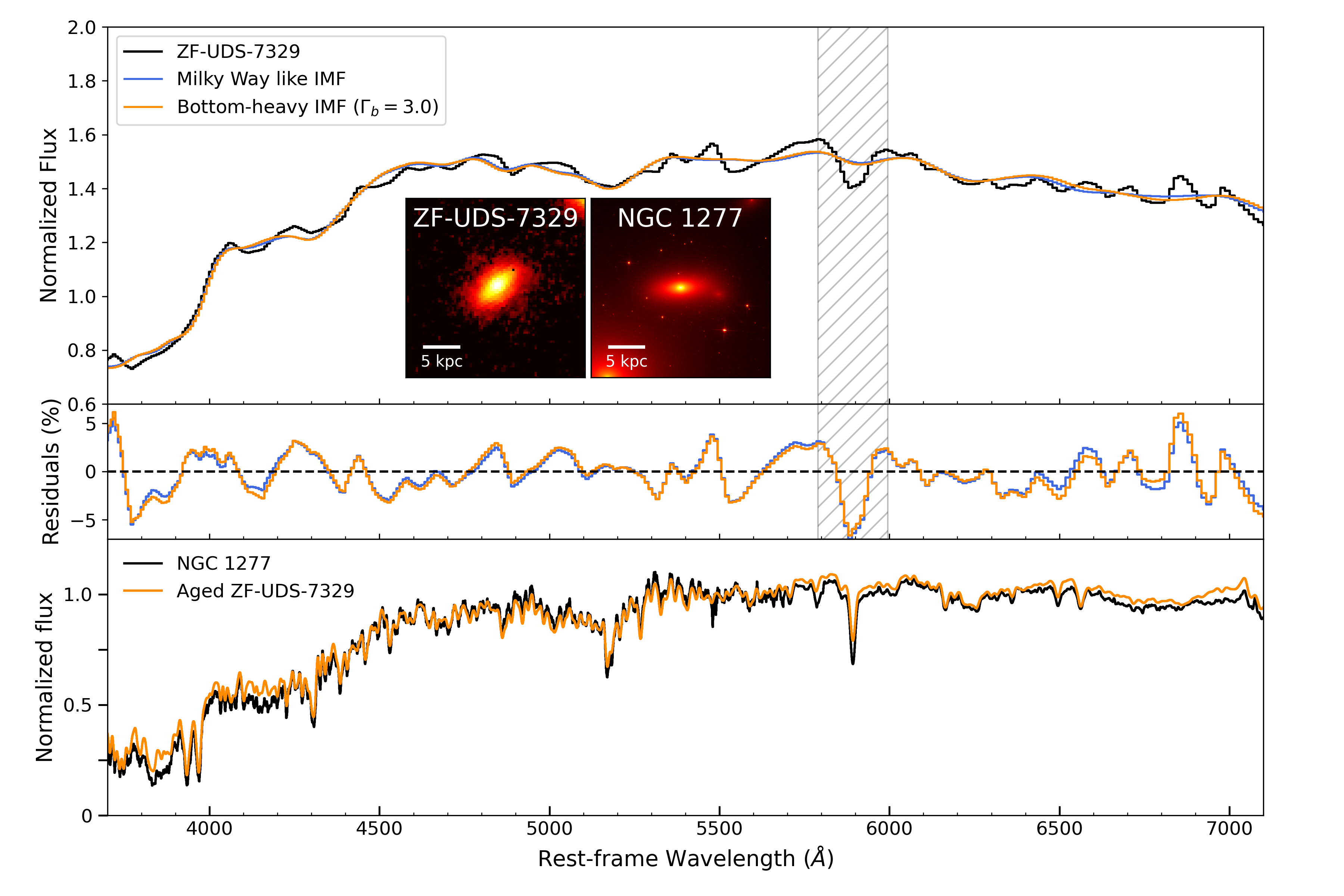
My collaborators and I analyzed some JWST observations made using PRISM of a super massive galaxy called ZF-UDS-7329, which is at a redshift of about 3.2. What we found is that studying galaxies at high redshift and thus much younger actually gives us the better time resolution we need to match those chemical formation timescales using stellar population synthesis. We also compared this massive galaxy to a well-known “relic” galaxy, NGC 1277, and we think ZF-UDS-7329 is an early universe version of what would become the dense cores of today’s massive elliptical galaxies – or even a relic galaxy itself, if it does not undergo any mergers.
You can check out the full letter here.